
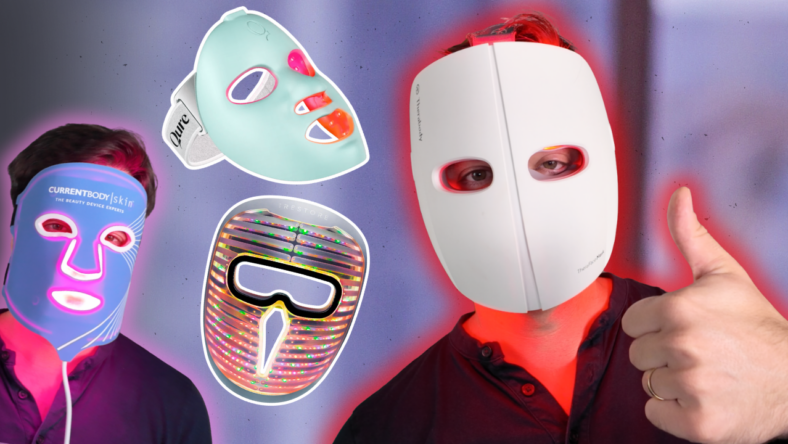
LED masks are an investment, but the right one can level up a solid skincare routine. Here are my favorites for every goal and budget.
“Do those red face masks actually work?” That is a question I get many times a year from friends and readers. And yes, they do work… if you use them enough. These red light masks are an investment, but they’re a smart one if you want firmer, clearer skin. That said, they should not replace a standard skincare regimen—instead, even the best LED face mask should merely enhance and support your baseline efforts.
I liken a red-light therapy mask to a leveling up of a standard skincare routine. Cleanser, moisturizer, morning sunscreen and ideally a nighttime retinol come first, so if you aren’t building a habit around those yet, I’m not trying to convert you. These LED masks only deliver what they promise if you use them as directed, and routinely.
I’ve tested tons of them over the years, and below are my absolute favorites, from the best overall to the best value and options for acne, quick daily sessions and full customization. A quick primer too: These masks aren’t all red light. Blue light is more surface-level and better at targeting acne, amber soothes the skin, and red, infrared and deep infrared penetrate progressively deeper to stimulate collagen, soften fine lines and improve firmness and suppleness. And one pick on my list even uses lasers…
If you have any other questions that will help you make an informed purchase, then jump to our LED mask buyer FAQs.
Quick Picks: The Best LED Face Masks for Men
- BEST OVERALL: Therabody TheraFace Mask / Brand Site (JUMP TO)
- BEST VALUE: Therabody TheraFace Mask Glo / Brand Site (JUMP TO)
- BEST QUICK TREATMENT: Dr. Dennis Gross DRx SpectraLite FaceWare Pro / Brand Site (JUMP TO)
- BEST FOR ACNE: CurrentBody Skin Anti-Acne LED Face Mask: Series 2 (JUMP TO)
- MOST CUSTOMIZABLE: Qure Q-Rejuvalight Pro / Brand Site (JUMP TO)
- BEST LASER-LED HYBRID: iRESTORE Laser Face Mask Pro / Brand Site (JUMP TO)
BEST OVERALL: TheraBody TheraFace Mask
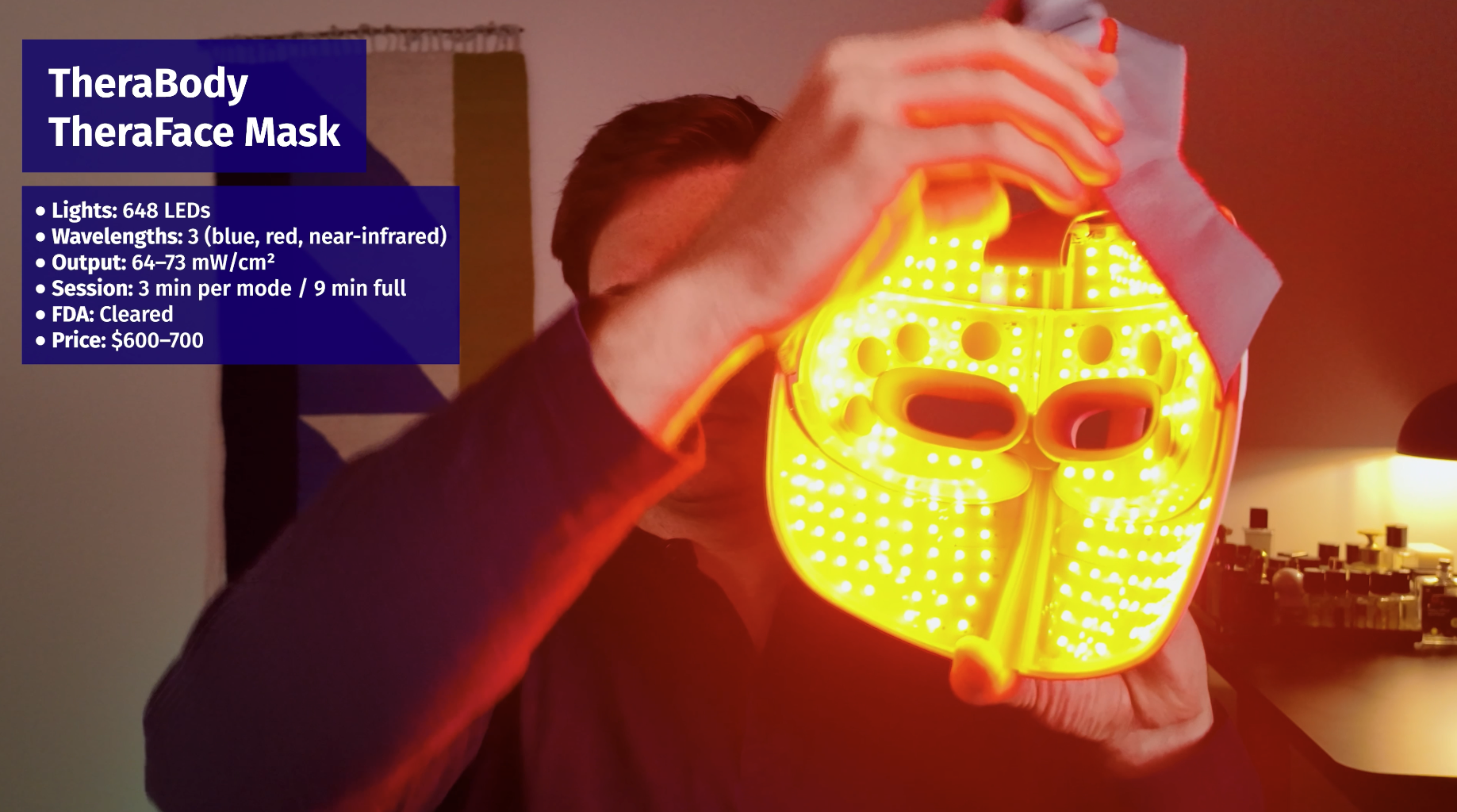
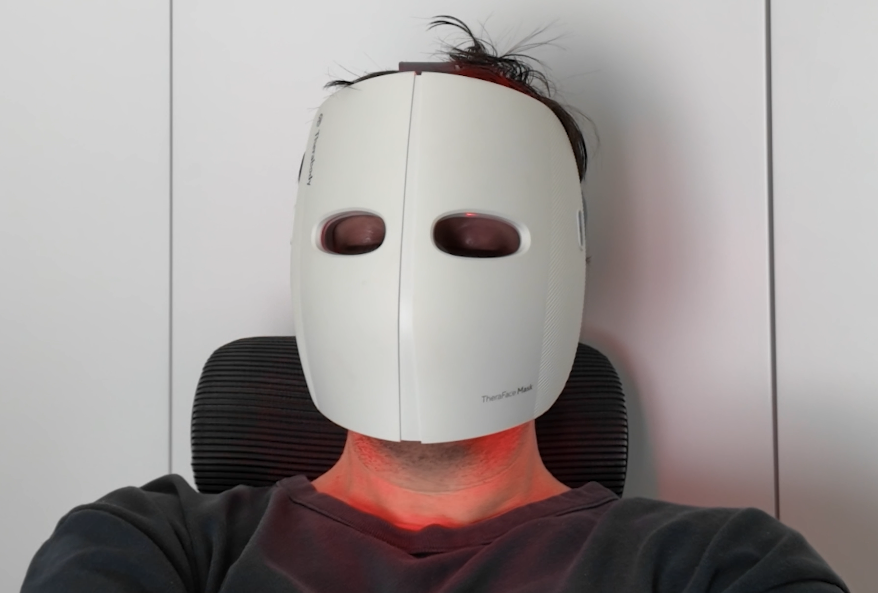
This is the LED mask I reach for routinely, when left to my own devices (literally). So, it’s the one I’d point most guys toward if budget isn’t the deciding factor (scroll to the next pick if you want a great value version of it). Yes, it looks a bit like Jason Voorhees’ hockey mask–all of these resemble something cheeky in that way, be it Hannibal Lector or a welder. But TheraBody’s spectacular mask packs 648 LEDs across blue, red and near-infrared light, so it covers everything from breakouts to fine lines in a single nine-minute routine (three minutes per light mode).
What sets it apart is the vibration massage built into that routine. I close my eyes, let it do its thing and zone out, and I’m genuinely a little sad when the session has to end, like when any massage comes to a close. You can also run a standalone vibration session if you just want the massage.
If that cost looks steep, remember this: An LED mask only pays off if you use it routinely, and this is the one I look forward to putting on, so it’s getting lots of mileage. Well worth it if you can keep up the same habit.
TheraBody TheraFace LED Mask Key Stats:
- Light Modes / Wavelengths: Blue 415 nm; red 633 nm; near-infrared 830 nm
- LED Count: 648 medical-grade LEDs
- Irradiance: Blue 64 mW/cm²; red 73 mW/cm²; red + NIR approximately 73 / 55 mW/cm², ±10%
- Treatment Protocol: 3 minutes per light mode; 9 minutes for the complete routine
- FDA Status: FDA-cleared
- Design / Fit: Rigid full-face mask with removable protective eye shields
- Special Feature: VibraWave vibration massage around the eyes, brow and scalp area
- Cordless / Battery: Yes
- Weight: 576 g
- Warranty: 1-year limited warranty
- Price Range: About $600-700
WATCH THE VIDEO: The Best LED Face Masks for Men
BEST VALUE: Therabody TheraFace Mask Glo
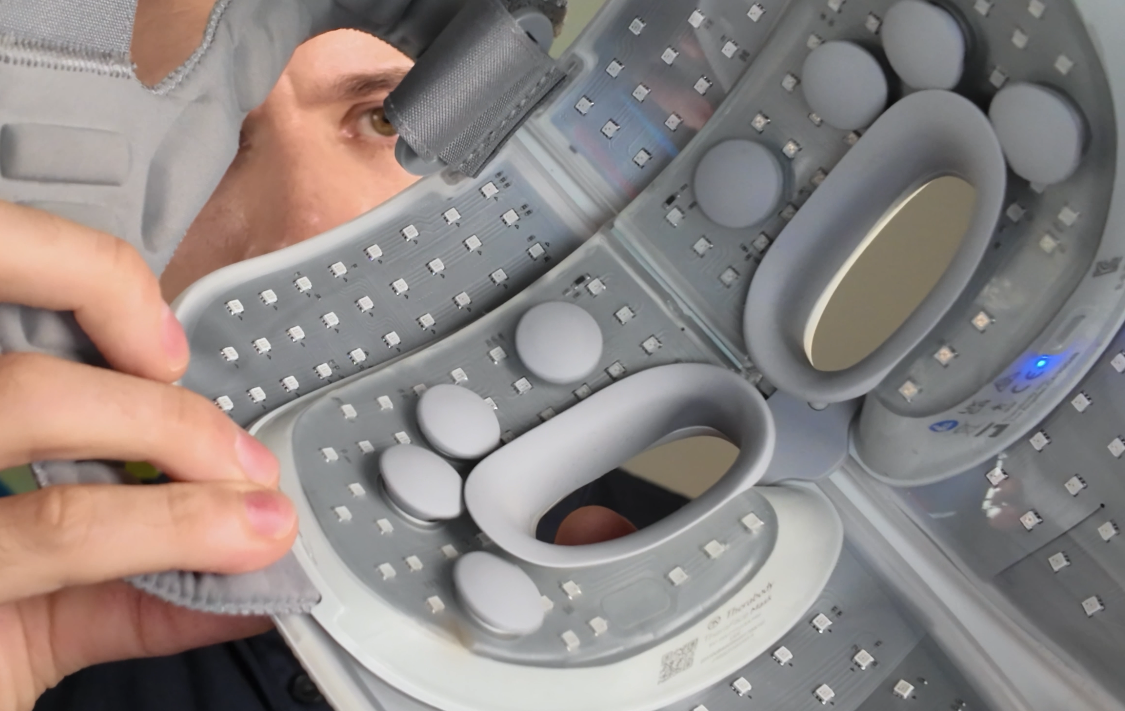
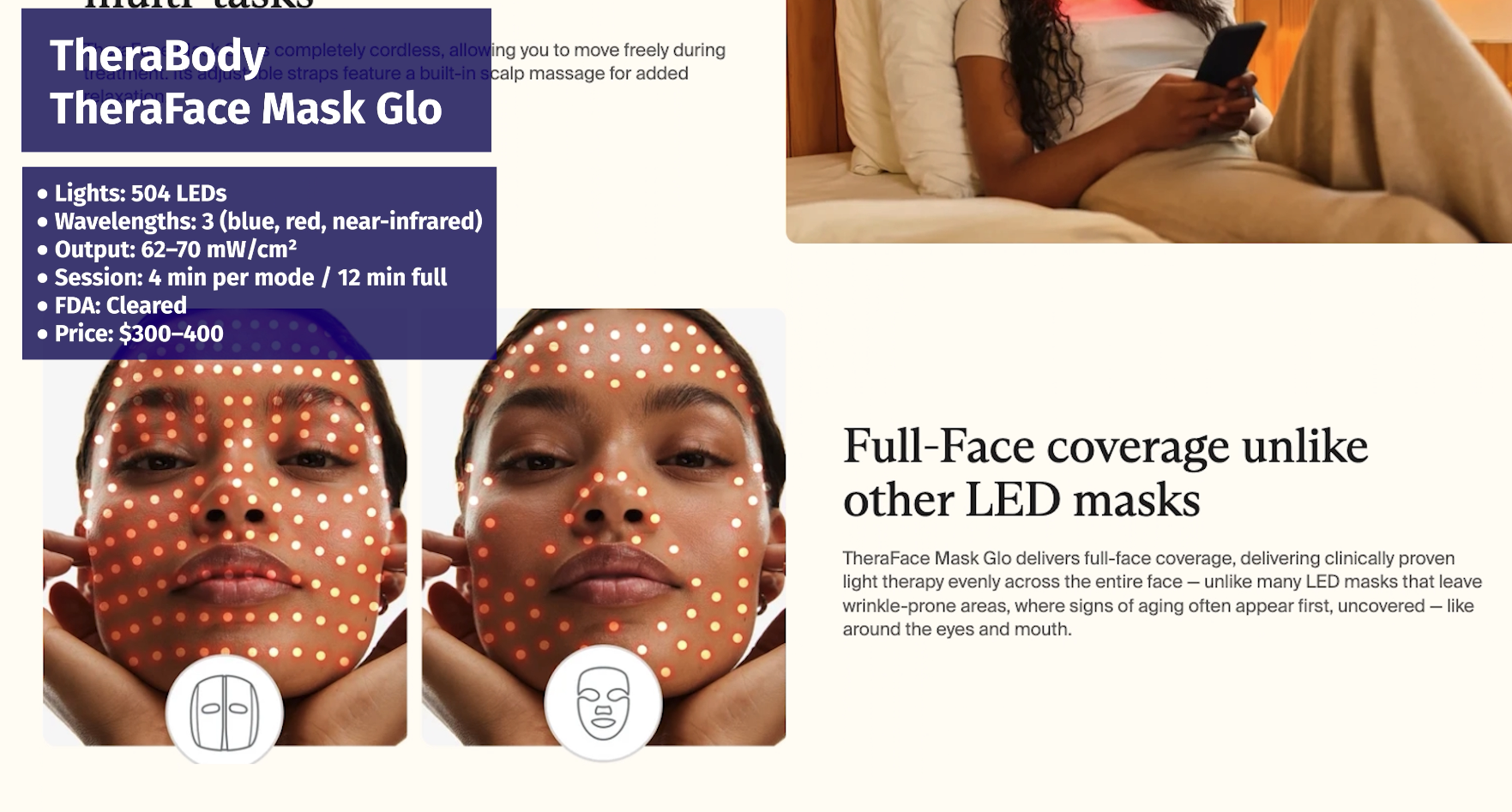
I’ll be upfront: I don’t own the Glo. I own its bigger sibling above, and the Glo is essentially a pared-down version of it. You get the same three wavelengths (blue, red and near-infrared), more than 500 LEDs and the VibraWave massage, for roughly half the price.
But there has to be a trade off, and in this case, it is your time. Each of its three light sessions runs four minutes instead of three, so the full routine takes 12 minutes rather than nine. If you’d rather spend a little less money and a little more time, it’s a smart buy. I still prefer the original, but I want you to know the better value exists.
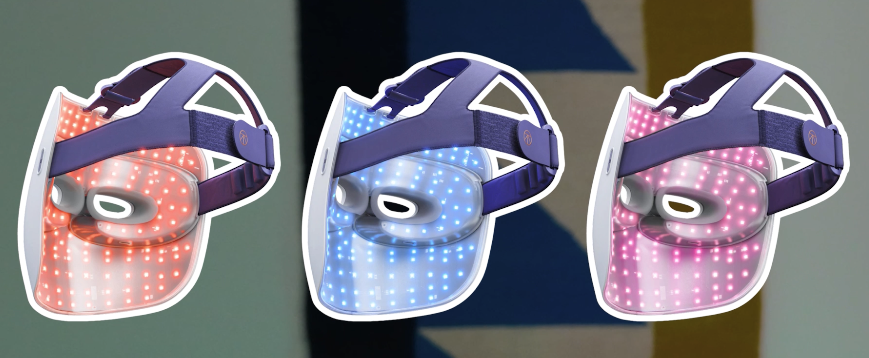
TheraBody TheraFace LED Mask Glo Key Stats:
- Light Modes / Wavelengths: Blue 415 nm; red 633 nm; near-infrared 830 nm
- LED Count: 504 medical-grade LEDs
- Irradiance: Blue 61.7 mW/cm²; red 70.4 mW/cm²; red + NIR approximately 70.4 / 53.0 mW/cm², ±10%
- Treatment Protocol: 4 minutes per light mode; 12 minutes for the complete routine
- FDA Status: FDA-cleared
- Design / Fit: Cordless full-face mask
- Special Feature: VibraWave scalp massage
- Cordless / Battery: Yes
- Weight: 514 g
- Warranty: 1-year limited warranty
- Price Range: About $300-400
BEST QUICK TREATMENT: Dr. Dennis Gross DRx SpectraLite FaceWare Pro
BUY ON AMAZON // DR. DENNIS GROSS
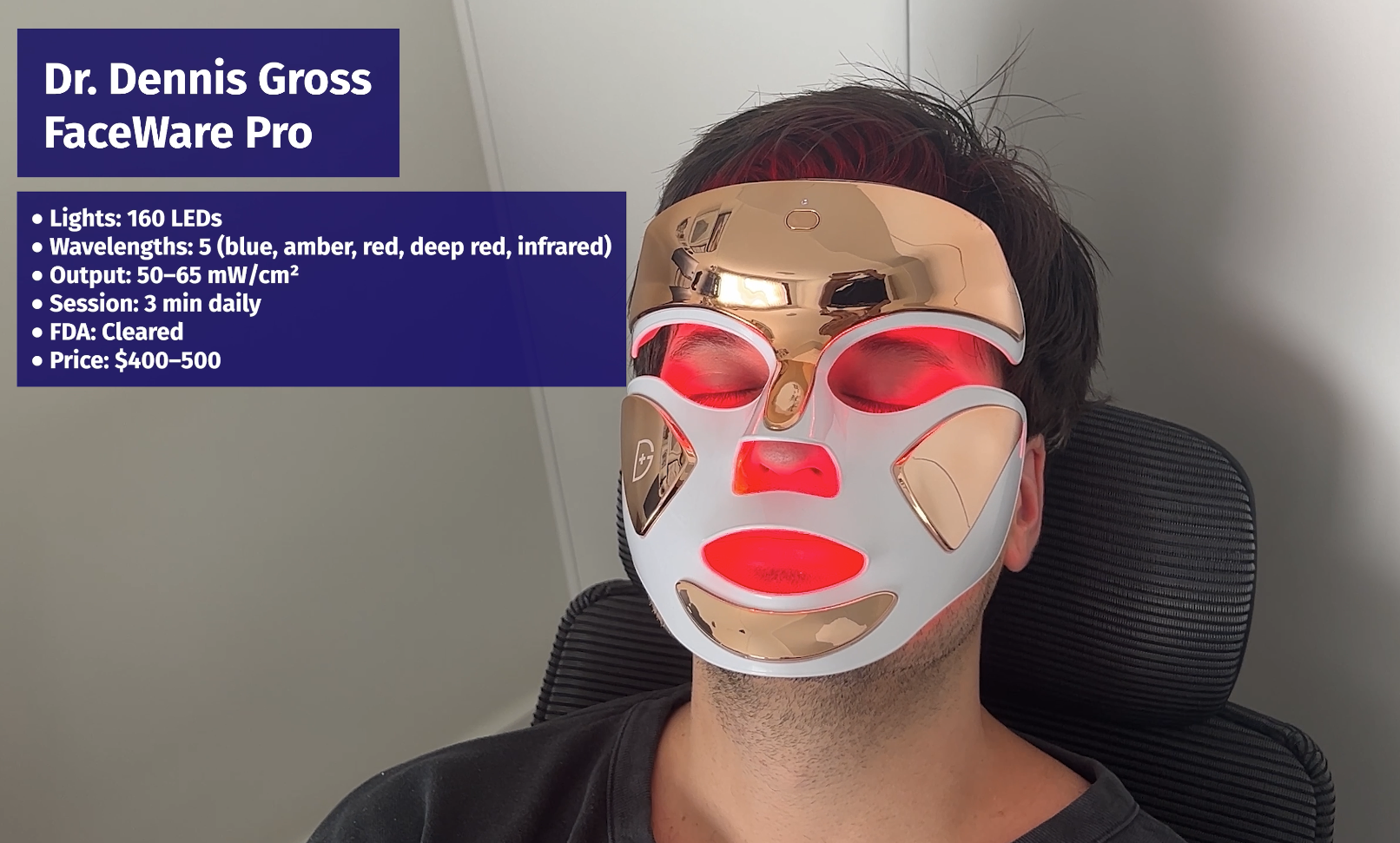
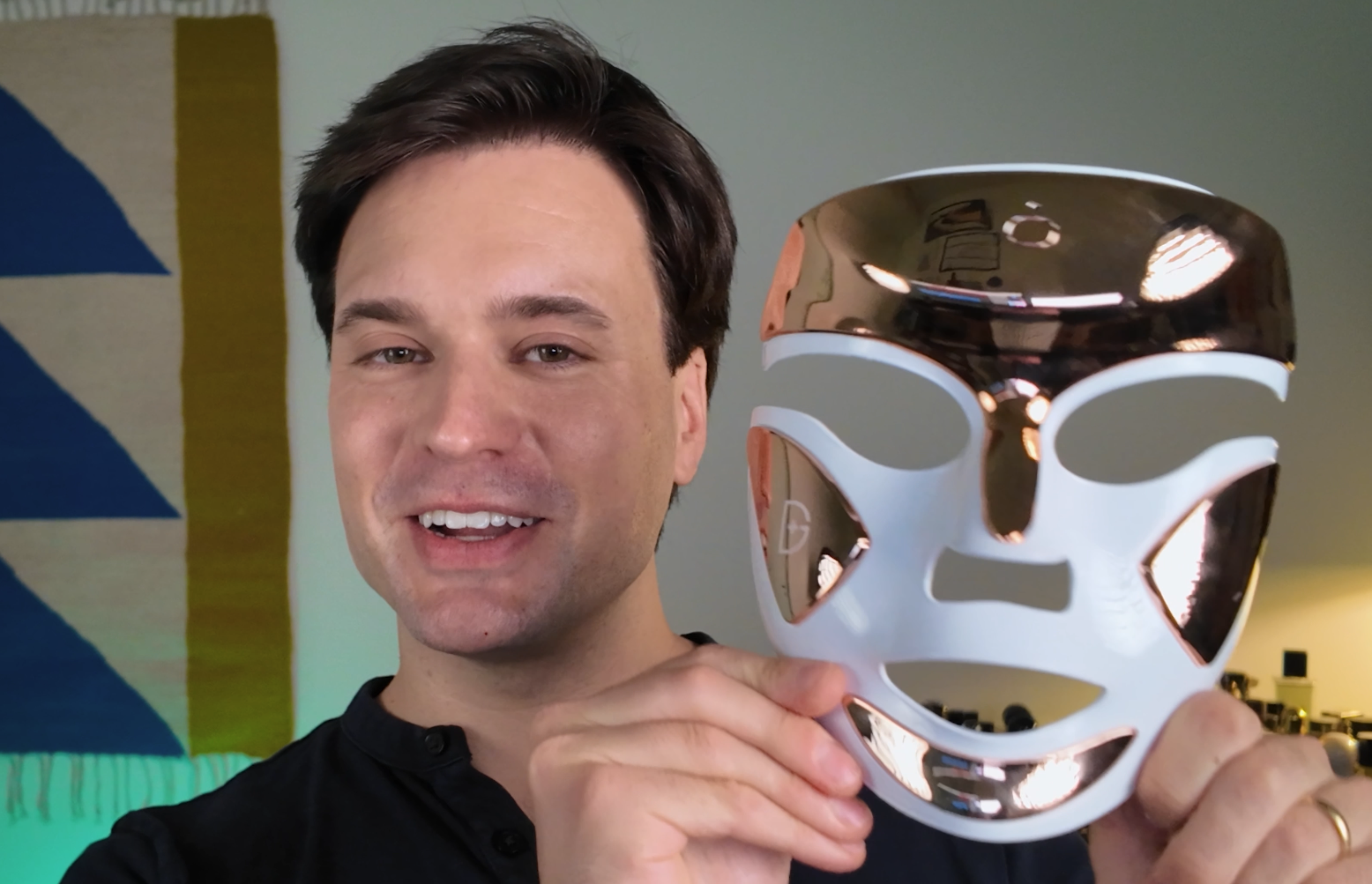
We’ve gone from Jason Voorhees to something closer to Hannibal Lecter by way of Eyes Wide Shut. Looks aside, this is one of the legacy devices in the category, and it did a lot to popularize at-home LED masks in the first place. You can run red light, blue light or both together.
Its real advantage is the three-minute session, designed for daily use. DDG’s mask the easiest of lot, especially to fit into a routine. That in turn makes the habit easy to build and keep. One personal preference tho: I find it more comfortable without the included silicone straps, so I take them off, lie back on a pillow and listen to music or a podcast while it lays against my mug.
Dr. Dennis Gross DRx SpectraLite FaceWare Pro Key Stats:
- Light Modes / Wavelengths: Blue 415 nm; amber 605 nm; red 630 nm; deep red 660 nm; infrared 880 nm
- LED Count: 160 lights total: 100 red-family + 60 blue
- Irradiance: Blue 50+ mW/cm²; red approximately 61–65 mW/cm²
- Treatment Modes: Red, blue, or combined red + blue
- Treatment Protocol: 3 minutes daily
- FDA Status: FDA-cleared
- Design / Fit: Rigid hands-free full-face design
- Power: Rechargeable
- Warranty: 1 year
- Price Range: About $400-500
BUY ON AMAZON // DR. DENNIS GROSS
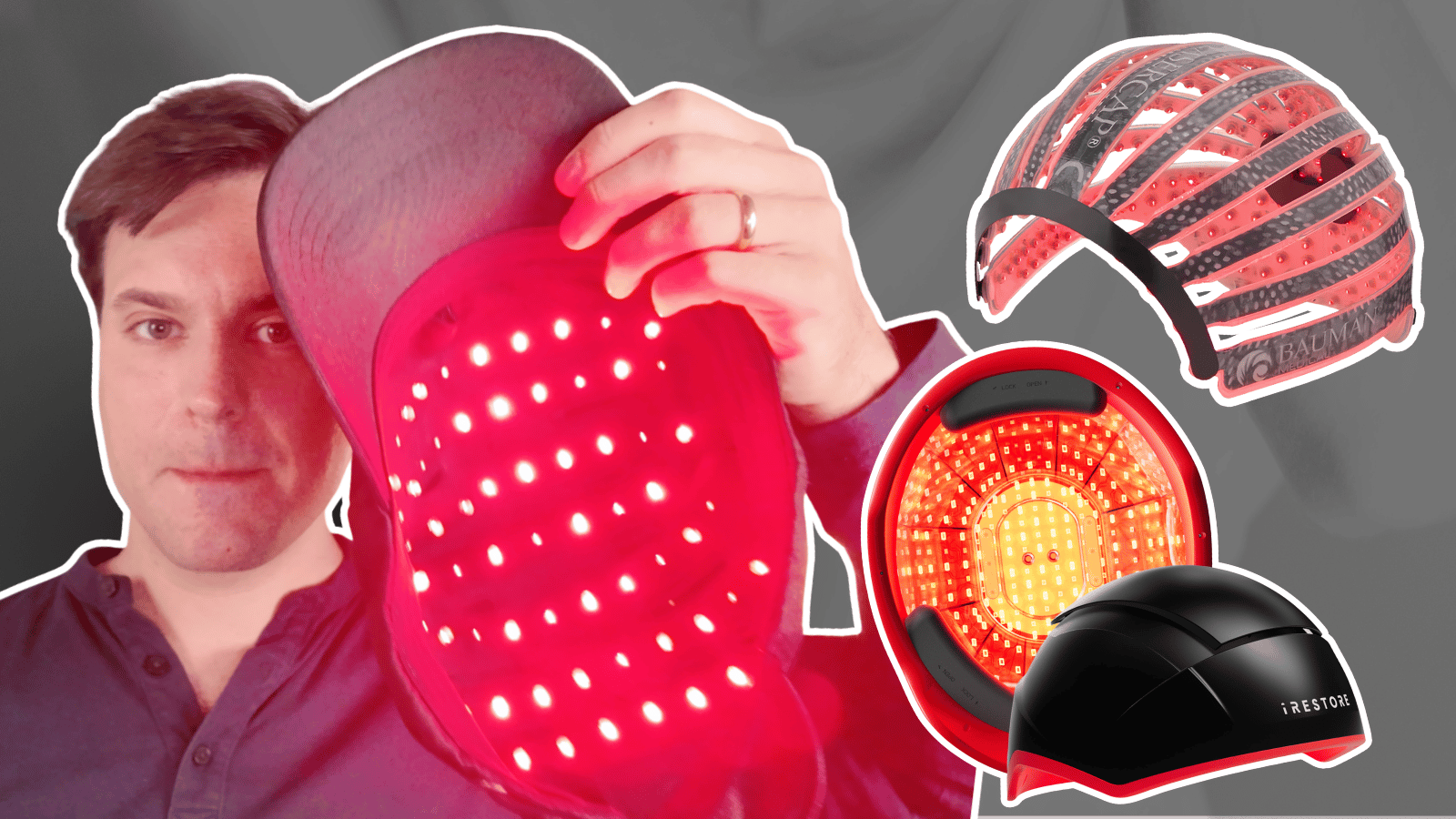
SEE ALSO: Best Laser Caps for Thicker Hair
BEST FOR ACNE: CurrentBody Skin Anti-Acne LED Face Mask: Series 2
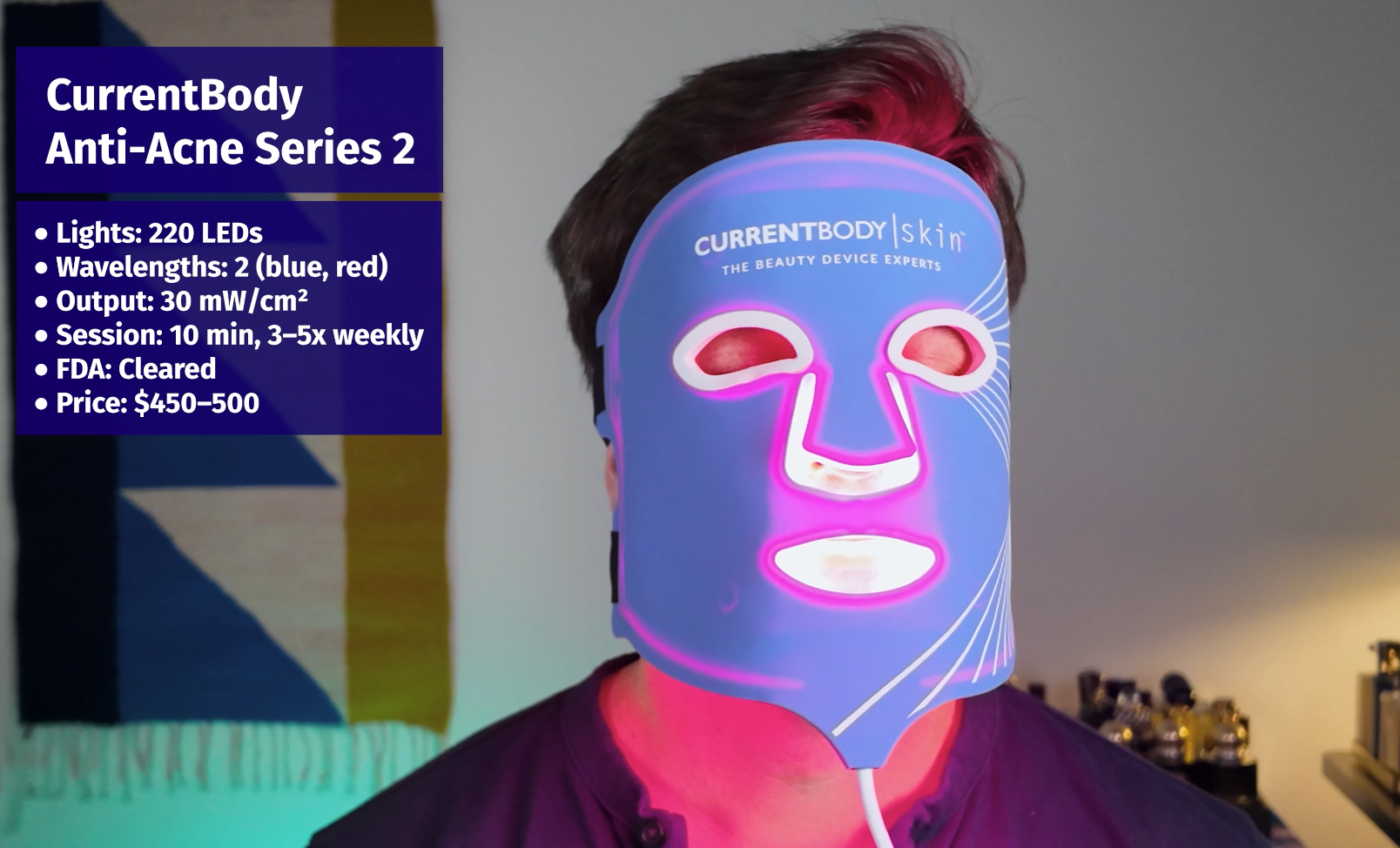
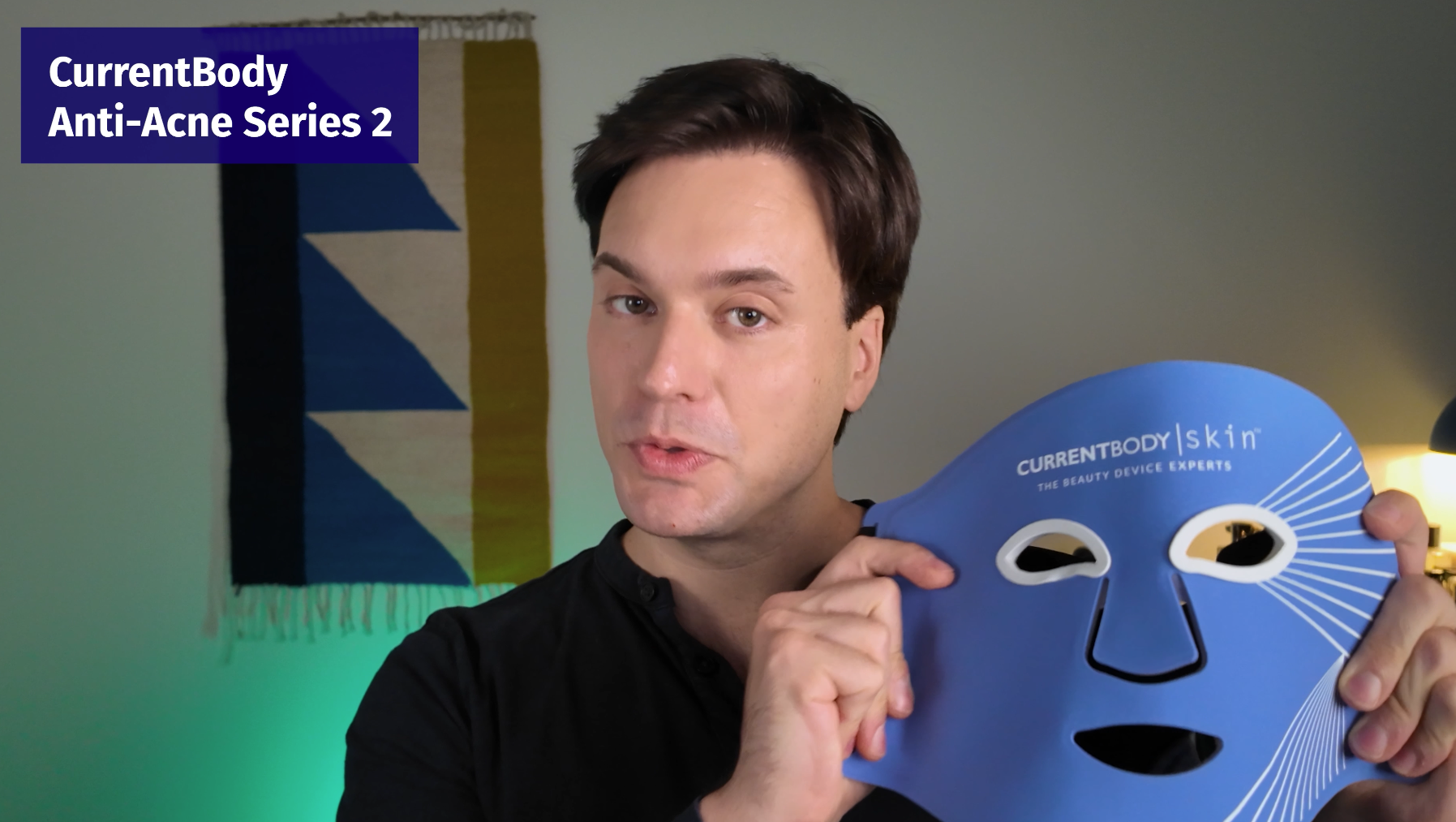
If acne is your main concern, this is the mask I’d buy. It pairs 110 blue LEDs, which target breakouts near the skin’s surface, with 110 red LEDs for some baseline collagen-stimulating benefits, and it cycles between the two during each session. It also extends further down the chin than most masks, which is useful if that’s where you tend to break out.
CurrentBody includes goggles for the blue-light treatment, which is a thoughtful touch. More broadly, CurrentBody is one of the leaders in this category, which is why it shows up twice in this roundup and the above embedded video.
CurrentBody Skin Anti-Acne Blue Light LED Mask Key Stats:
- Light Modes / Wavelengths: Blue 415 nm + red 633 nm
- LED Count: 220 LEDs: 110 blue + 110 red
- Irradiance: 30 mW/cm²
- Treatment Protocol: 10 minutes, 3–5 times weekly for 6 weeks, followed by a short break before another cycle
- FDA Status: FDA-cleared
- Design / Fit: Flexible full-face design with expanded chin coverage
- Eye Protection: Protective goggles provided; follow CurrentBody’s blue-light instructions
- Power: Rechargeable controller/battery system
- Warranty: 2 Years
- Price Range: About $450-500
See Also: CurrentBody Skin LED Light Therapy Mask: Series 2
BUY ON AMAZON // CURRENTBODY
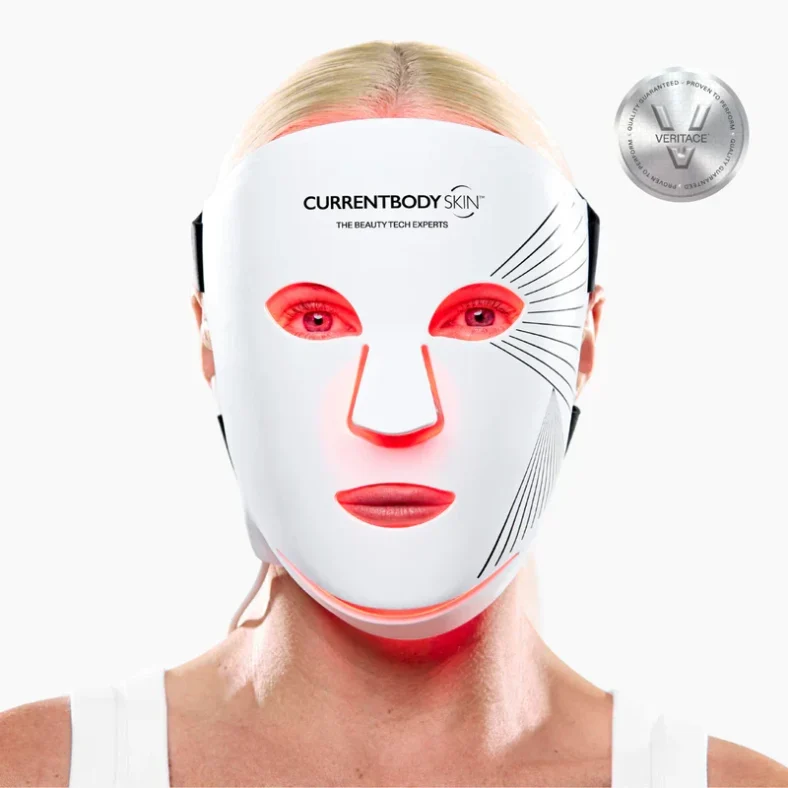
CurrentBody’s standard Series 2 mask is one of the best red-light masks out there, and it’s the one I’d consider if anti-aging is your priority. It skips blue light entirely and pairs red and near-infrared with deep near-infrared at 1072 nm, which makes it one of the deepest-penetrating options you can buy. Food for thought if breakouts aren’t your issue. They did even launch a Series 3 between the time I recorded the video for this article and hit “publish”, so… food for thought in terms of a great upgrade. (That device offers SIX different colors, from Blue to deep near infrared.)
CurrentBody Skin LED Mask Series 2 Key Stats:
- Light Modes / Wavelengths: Red 633 nm; near-infrared 830 nm; deep near-infrared 1072 nm
- LED Count: 236 LEDs
- Irradiance: 30 mW/cm²
- Treatment Protocol: 10 minutes, 3–5 times weekly
- FDA Status: FDA-cleared
- Design / Fit: Flexible silicone mask
- Blue Light: No
- Warranty: 2 Years
- Price Range: About $450-500
BUY ON AMAZON // CURRENTBODY
MOST CUSTOMIZABLE: Qure Q-Rejuvalight Pro
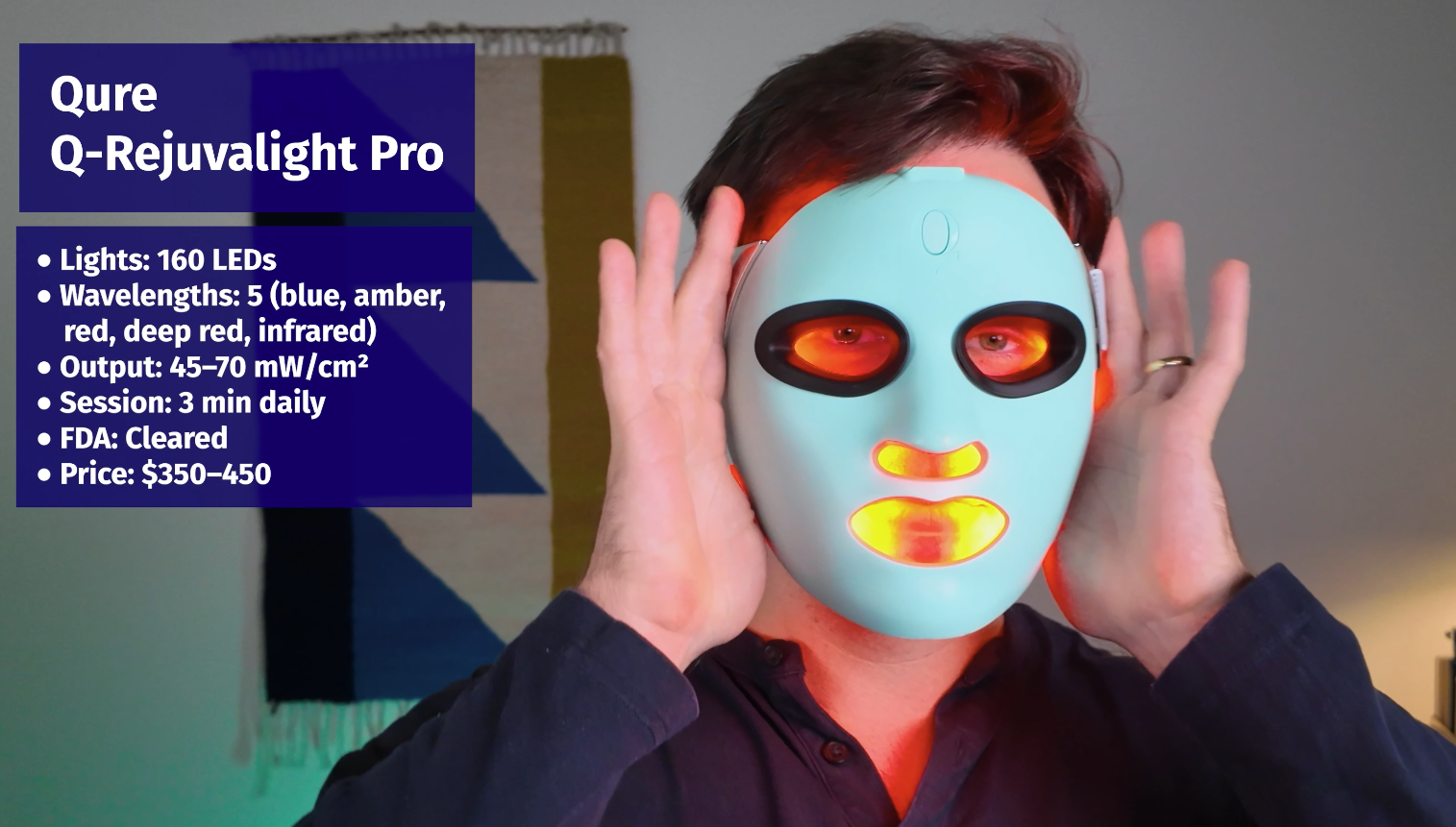
Aside from the new CurrentBody Series 3 that I mentioned above (which just launched), Qure’s customizable mask is unmatched. It’s called the Rejuvalight, which isn’t my favorite name but at least the experience of using this mask is profoundly favorable.
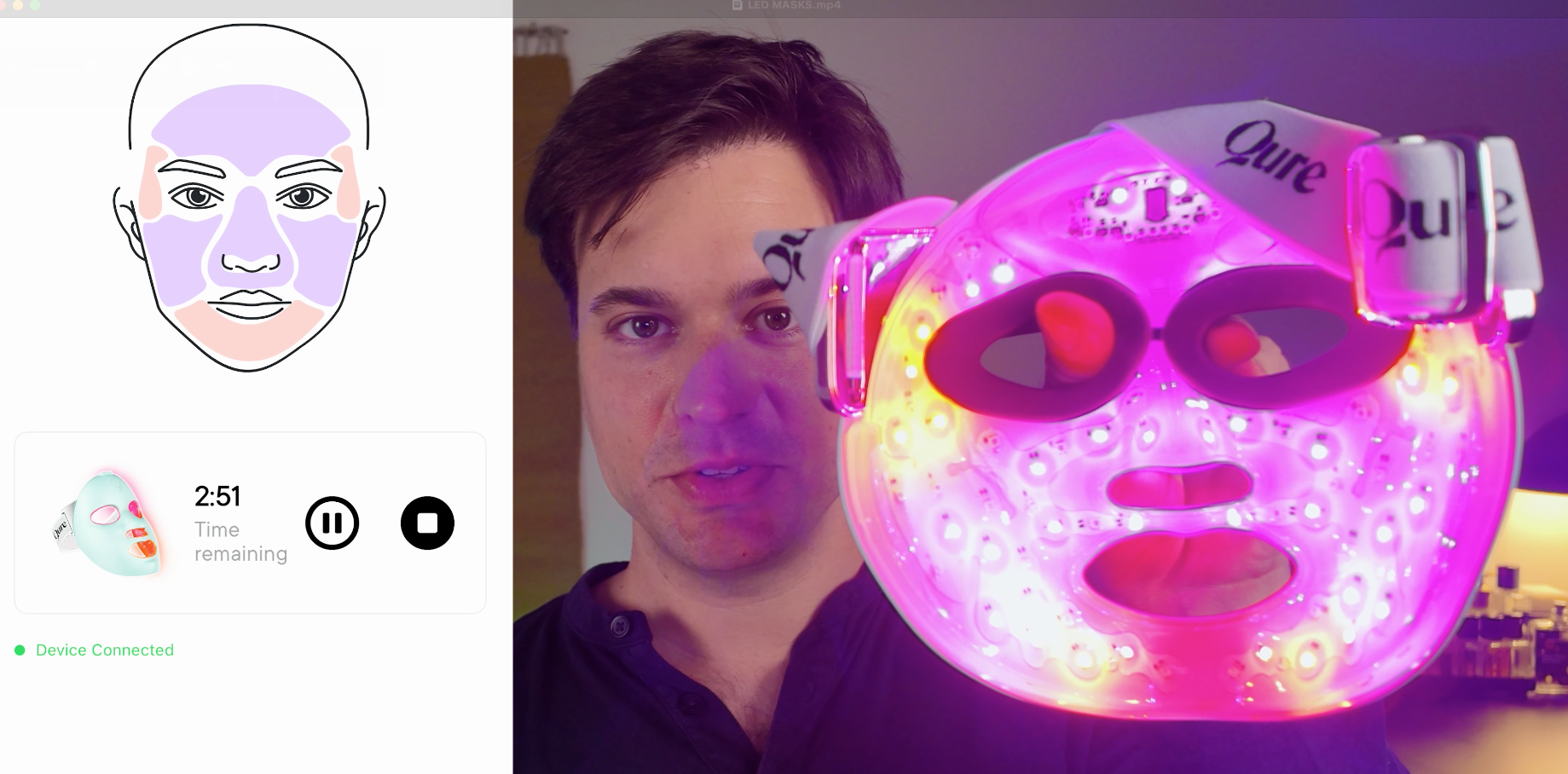
You get five types of light: blue for acne, amber for soothing, then red, deep red and infrared for deeper-penetrating repair. But beyond that color range, what makes it customizable is the app. It divides your face into five zones, and you can assign a different treatment to each. If you break out on your forehead and nose but want anti-aging light around your eyes and chin, you can set it up exactly that way, then hit start. The app runs the timer and can send reminders, which helps with the habit. I don’t usually love devices that require an app, but this is a case where it’s well deployed and rationalized.
Qure Q-Rejuvalight Pro Mask Key Stats:
- Light Modes / Wavelengths: Blue 415 nm; amber 605 nm; red 630 nm; deep red 660 nm; infrared 880 nm
- LED Count: 160 dual-core LEDs
- Irradiance: 45 mW/cm² (acne mode) / 70 mW/cm² (wrinkle mode), per its FDA 510(k) filing
- Treatment Modes: Skin Rejuvenating, Skin Clearing + custom treatment
- Customization: App-based programming across 5 individual facial zones
- Treatment Protocol: 3 minutes daily
- FDA Status: FDA-cleared
- Design / Fit: Rigid, cordless, hands-free design
- Power: Rechargeable
- Warranty: 1 year
- Price Range: About $350-450
BEST LASER-LED HYBRID: iRESTORE Laser Face Mask Pro
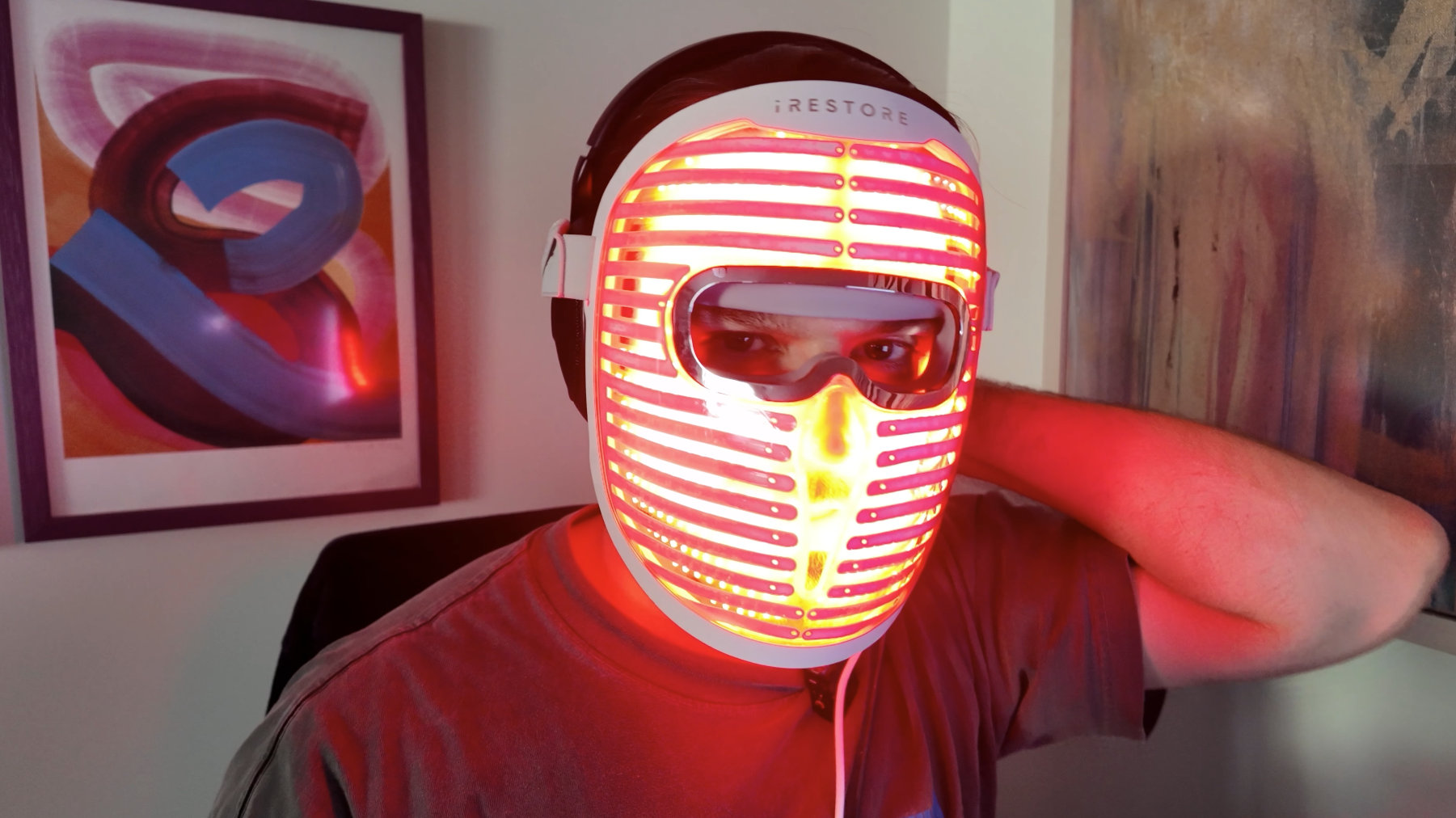
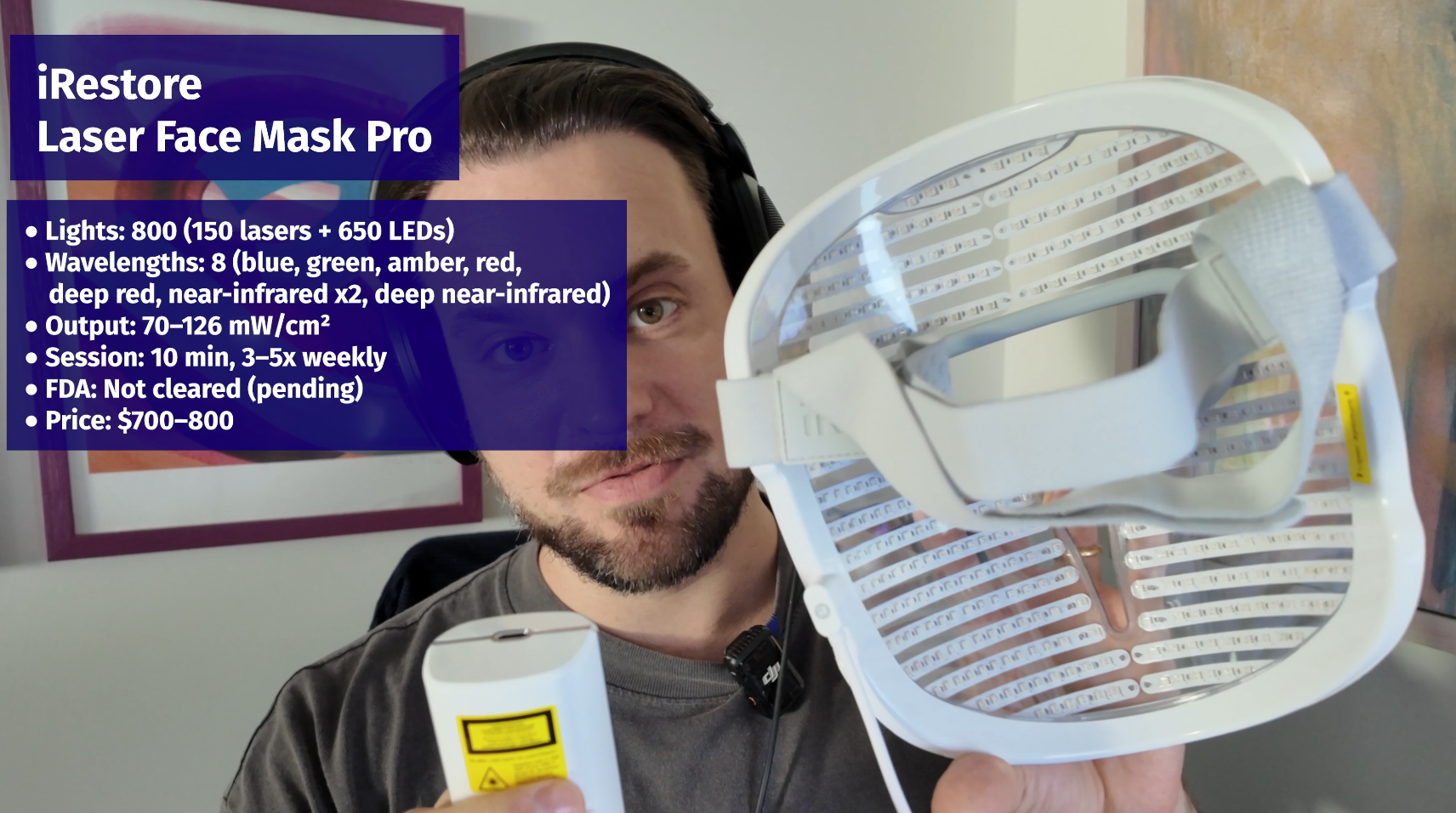
This is one of the newest masks on the list. And, yes, this welder-like face shield is on the higher end at almost $700. It’s also the only mask here with lasers, too: 150 of its 800 diodes are lasers, and the other 650 are LEDs.
Perhaps you’re wondering what the lasers add or how they differ from LEDs: Both lasers and LEDs can deliver the wavelengths used in light therapy, but they spread that light differently. A laser sends out a tighter, more directional beam, while an LED disperses its light over a wider area. Pairing them gives you more concentrated delivery from the lasers and even, full-face coverage from the LEDs. As with laser caps, the kind of light source tells you more than the total diode count, so 150 lasers is the number to pay attention to here.
A small controller plugs in and lets you cycle through five color-changing modes: Anti-Aging, Clear, Brighten, Restore and All, which runs every wavelength at once. The mask won’t switch on unless you’re wearing it properly, and sessions are 10 minutes, three to five times a week. My favorite detail is that it hovers off the face instead of resting against it, so there’s very little skin contact and it’s easy to keep clean.
Two things to weigh: unlike every other mask here, it isn’t FDA-cleared yet (iRESTORE says clearance is pending), and the price is steep. iRESTORE does offer a 100-day return window, though, which takes some of the risk out of trying it.
iRESTORE Laser Face Mask Pro Key Stats:
- Light Source: 800 total diodes: 150 lasers + 650 LEDs
- Light Modes / Wavelengths: Lasers at red 660 nm and near-infrared 850 nm; LEDs at blue 415 nm, green 532 nm, amber 590 nm, red 633 nm, near-infrared 830 nm and deep near-infrared 1072 nm
- Irradiance: 70–126 mW/cm² depending on mode; 126 mW/cm² in All mode
- Treatment Modes: Anti-Aging, Clear, Brighten, Restore, All
- Treatment Protocol: 10 minutes, 3–5 times weekly
- FDA Status: Not FDA-cleared; the brand lists 510(k) clearance as pending
- Design / Fit: Semi-rigid shell with ventilated skin-contact points, open mouth, extended chin and jowl coverage, silicone eye shields
- Special Feature: Fit sensor keeps the lasers off until the mask is positioned correctly
- Cordless / Battery: Yes; USB-C rechargeable controller, about 1–2 weeks per charge
- Warranty: 2 years standard; optional 4-year extension
- Guarantee: 100-day money-back guarantee, subject to brand terms
- Price Range: About $700-800
LED Mask Buyer’s Guide FAQs
All the most important questions about LED masks and terminology, answered.
What does an LED face mask actually do?
An LED mask exposes the skin to selected wavelengths of low-intensity light. Different wavelengths are chosen because they interact with the skin in different ways, which is why today’s masks may contain red, blue, near-infrared or several types of light within the same device. “Red-light mask” has become a convenient category name, but it doesn’t accurately describe every product in the category.
How do red, blue and near-infrared light differ?
They are not interchangeable treatments.
- Blue light, commonly around 415 nm in these masks, is primarily associated with acne treatment.
- Red light, usually somewhere around 630 nm, is more commonly used in devices aimed at visible skin rejuvenation and inflammatory processes.
- Near-infrared light uses longer wavelengths that we cannot see and that reach deeper into tissue than visible red light.
Some devices add amber, deep-red or longer near-infrared wavelengths as part of a broader treatment program.
What does “nm” mean?
It stands for nanometers, the unit used to describe the wavelength of light. A 415-nm blue LED and a 633-nm red LED are doing more than simply producing different colors. Their wavelengths determine how the light behaves in tissue and help explain why they are used for different skincare goals.
What is irradiance?
Irradiance tells you how intensely light is being delivered across a given area of skin and is usually expressed in milliwatts per square centimeter. It’s useful information, but it doesn’t tell the whole story. Treatment length also matters, so a mask operating at a lower irradiance for ten minutes cannot be fairly judged against a higher-irradiance mask running for three minutes without considering the total exposure.
What does “dose” mean in LED therapy?
Dose, or fluence, refers to the total amount of light energy delivered to the skin during one session. In simple terms, both intensity and time contribute to the final dose. That is why treatment duration shouldn’t be viewed independently of a mask’s light output.
Is a mask with hundreds more LEDs automatically more effective?
No. More LEDs may help a device spread light evenly across the face, but the raw count doesn’t reveal wavelength, intensity, positioning, treatment time or total energy delivery. A 600-plus-LED mask therefore isn’t automatically several times more effective than one with 160 LEDs.
How is a laser face mask different from an LED mask?
Both can deliver the red and near-infrared wavelengths used in skin-focused light therapy, but they distribute light differently. A laser diode produces a narrower and more directional beam, while an LED spreads its light across a broader area. Hybrid masks like the iRESTORE Laser Face Mask Pro pair the two: lasers for more concentrated delivery, LEDs for even coverage across the face.
Still, don’t assume the word “laser” makes a mask more effective. The same variables apply as with any LED mask: wavelength, output, treatment time and how consistently you use it. Also check the FDA status, since laser masks are newer to the at-home market and not every one has been cleared.
Why do some masks contain five wavelengths while others use only two?
A multi-wavelength device is designed to address several treatment goals or depths of tissue within one system. That doesn’t automatically make it a better choice. A mask built specifically around two wavelengths may be more relevant if those wavelengths align directly with the skin issue you’re trying to address.
What does FDA-cleared mean for an LED mask?
FDA clearance is a regulatory designation commonly used for medical devices like LED masks. A manufacturer must show that its device is sufficiently comparable in intended use, safety and effectiveness to another legally marketed device. “FDA-cleared” is different from “FDA-approved.” Approval typically refers to the FDA’s more rigorous Premarket Approval process for higher-risk Class III medical devices.
Consumer LED masks generally fall into the clearance pathway instead, so you should be skeptical of a mask marketed as “FDA-approved” unless the manufacturer can point to an actual FDA approval. And neither designation means the FDA has compared competing masks and decided which one works best.
Should I wear eye protection with an LED mask?
Use whatever eye-protection method the manufacturer specifies for that particular device. Some masks are designed with built-in shielding, while others include goggles or removable eye inserts. Instructions may also differ depending on which wavelengths are being used, particularly with blue-light treatments.
Is blue light suitable for every complexion?
Blue-light therapy deserves extra consideration for people who are prone to pigment changes. Some manufacturers specifically warn that darker skin tones may have a greater chance of experiencing temporary hyperpigmentation after blue-light exposure. Similar to people with fair skin who get dark spots routinely: these blue lights could exacerbate those dark spots and prevent them from disappearing faster. If pigmentation is already a significant concern, it is worth discussing blue-light treatment with a dermatologist before committing to regular use.
Is a flexible mask better than a rigid one?
They solve the fit problem differently:
- A rigid mask maintains a fixed distance and orientation between its LEDs and your face and can accommodate features such as vibration motors or independently controlled treatment zones.
- A flexible silicone mask conforms more closely to the contours of the individual face and often feels less bulky.
Neither approach is inherently superior. Coverage, comfort and your willingness to wear the thing consistently matter more.
Can I leave an LED mask on longer to get faster results?
Don’t treat the recommended session time as a minimum. Each mask is designed around a particular combination of wavelength, output and exposure time. Extending the session changes the amount of light your skin receives and has not necessarily been shown to improve the outcome. Use the treatment schedule developed for the specific device rather than trying to maximize exposure on your own.